
Physical Profile
Tolosa is a coastal municipality in the province of Leyte.
The municipality has a land area of 22.54 square kilometers or 8.70 square miles which constitutes 0.36% of Leyte’s total area. Its population as determined by the 2020 Census was 20,708. This represented 1.17% of the total population of Leyte province, or 0.46% of the overall population of the Eastern Visayas region. Based on these figures, the population density is computed at 919 inhabitants per square kilometer or 2,380 inhabitants per square mile.
Demographic Profile
| 10 Digit Code: | 0803749000 |
| Correspondence Code: | 083749000 |
| Income Class | Population (2020 Census) |
|---|---|
| 5th | 20,708 |
| Barangays | 10 Digit Code | Correspondence Code | Urban/Rural | Population (2020 Census) |
|---|---|---|---|---|
| Burak | 0803749001 | 083749001 | Rural | 660 |
| Canmogsay | 0803749002 | 083749002 | Rural | 758 |
| Cantariwis | 0803749003 | 083749003 | Rural | 506 |
| Capangihan | 0803749004 | 083749004 | Rural | 635 |
| Malbog | 0803749005 | 083749005 | Rural | 1,125 |
| Olot | 0803749006 | 083749006 | Rural | 1,124 |
| Opong | 0803749007 | 083749007 | Urban | 2,170 |
| Poblacion | 0803749008 | 083749008 | Rural | 841 |
| Quilao | 0803749009 | 083749009 | Rural | 1,666 |
| San Roque | 0803749010 | 083749010 | Urban | 3,364 |
| San Vicente | 0803749011 | 083749011 | Rural | 937 |
| Tanghas | 0803749012 | 083749012 | Rural | 2,235 |
| Telegrafo | 0803749013 | 083749013 | Rural | 2,478 |
| Do�a Brigida | 0803749014 | 083749014 | Rural | 1,622 |
| Imelda | 0803749015 | 083749015 | Rural | 587 |
Further information about the population structure:
| Gender | Persons |
|---|---|
| Males | 10,559 |
| Females | 10,134 |
| Gender (C 2020) | |
|---|---|
| Males | 10,559 |
| Females | 10,134 |
| Age Groups | Persons |
|---|---|
| 0-14 years | 6,810 |
| 15-64 years | 12,586 |
| 65+ years | 1,297 |
| Age Groups (C 2020) | |
|---|---|
| 0-14 years | 6,810 |
| 15-64 years | 12,586 |
| 65+ years | 1,297 |
| Age Distribution | Males | Females |
|---|---|---|
| 80+ years | 69 | 140 |
| 70-79 years | 256 | 336 |
| 60-69 years | 551 | 610 |
| 50-59 years | 884 | 817 |
| 40-49 years | 1119 | 1004 |
| 30-39 years | 1417 | 1260 |
| 20-29 years | 1780 | 1627 |
| 10-19 years | 2094 | 2091 |
| 0-9 years | 2389 | 2249 |
| Age Distribution (C 2020) | |
|---|---|
| 80+ years | 209 |
| 70-79 years | 592 |
| 60-69 years | 1,161 |
| 50-59 years | 1,701 |
| 40-49 years | 2,123 |
| 30-39 years | 2,677 |
| 20-29 years | 3,407 |
| 10-19 years | 4,185 |
| 0-9 years | 4,638 |
Socio-economic Profile
Health and Nutrition
In Tolosa, Leyte, there are ongoing efforts to address health and nutrition, including initiatives by Visayas State University (VSU) with WHO and SIKAP, focusing on social determinants of health and promoting health and promoting healthy lifestyles, alongside nutrition program management training for local advocates. ( Source: AI Overview)
Infrastructure and Utilities
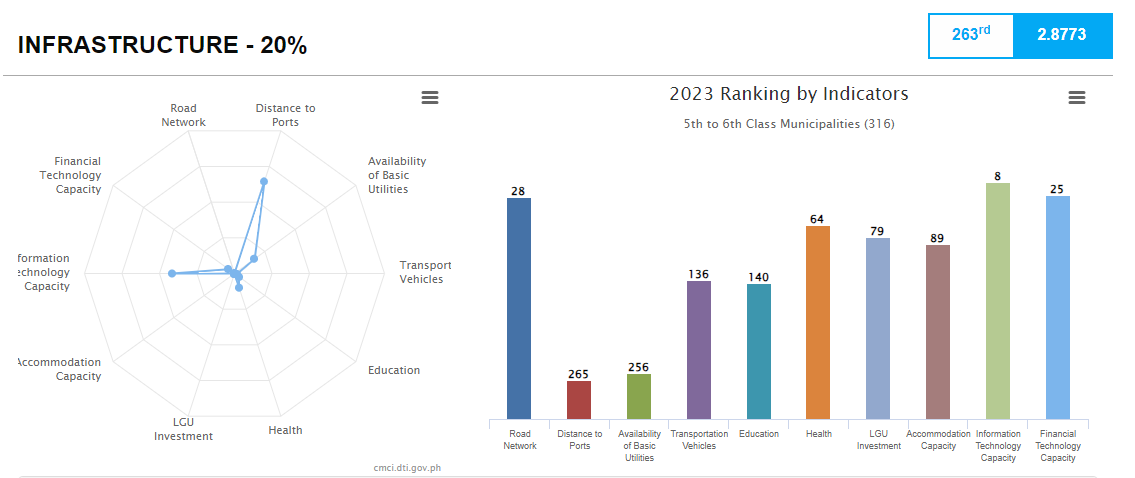
Tolosa, Leyte’s Municipal Building, located in Barangay Imelda, is the central hub of its local government. It contains the offices of the mayor, the municipal council, and a range of local government departments.
Tolosa, Leyte, is served by a Municipal Trial Court (MTC), an integral part of the Philippine judicial system. Situated within the Municipal Building in Barangay Emelda, along San Miguel Street, the MTC is the venue for local judicial proceedings, ensuring access to justice for the community.
Irrigation in Tolosa, Leyte, is primarily managed by the National Irrigation Administration (NIA) Region VIII, which oversees the development and maintenance of irrigation systems crucial for the area’s agricultural activities, particularly rice farming; these systems are interconnected with regional water management efforts, including projects within the “Picas San Vicente CIS (Tolosa Side)” and flood control initiatives like the “Construction of Tolosa Tide Embankment,” all contributing to the sustainability of local agriculture within the broader Leyte Sab-a Basin.
The Don Orestes Romualdez Electric Cooperative, Inc. (DORELCO) supplies electricity to Tolosa, Leyte, and a cluster of surrounding municipalities, including Tabontabon, Burauen, Julita, and Dulag, operating from its base in San Roque, Tolosa, effectively serving as the primary power distributor for this region of Eastern Visayas.
|
Tolosa
|
|
|---|---|
| Municipality of Tolosa | |
.jpg) |
|
|
Flag
|
|
|
Nickname: Home of Catmon Hill
|
|
|
Map of Leyte with Tolosa highlighted
|
|
| Income class: 5th | |
|
 Tolosa
Location within the Philippines
|
|
| Coordinates: 11°03′48″N 125°02′07″E | |
| Country | Philippines |
| Region | Eastern Visayas |
| Province | Leyte |
| District | 1st district |
| Barangays | 15 (see Barangays) |
| Government | |
| • Type | Sangguniang Bayan |
| • Mayor | Erwin C. Ocaña |
| • Vice Mayor | Menardo M. Mate |
| • Representative | Ferdinand Martin G. Romualdez |
| • Councilors |
List:
|
| • Electorate | 15,238 voters (2022) |
| Area | |
|
• Total
|
22.54 km2 (8.70 sq mi) |
|
Elevation |
21 m (69 ft) |
|
Highest elevation |
779 m (2,556 ft) |
|
Lowest elevation |
0 m (0 ft) |


.svg)

Source of Livelihood
The primary sources of living in Tolosa, Leyte, include agriculture, where farming and crop production are significant livelihoods; fishing, a vital economic activity due to its coastal location; livestock and poultry production, which contributes to the local economy; trading, providing income for many residents; and employment in various sectors, both within and outside the municipality.
Languages
The linguistic landscape of Tolosa, Leyte, and the encompassing Eastern Visayas region is primarily characterized by the prevalence of Waray-Waray, also known as Lineyte-Samarnon, which serves as the dominant regional language. Alongside this, Filipino, the national language of the Philippines, enjoys widespread comprehension and usage. English, furthermore, maintains a significant presence, particularly within educational, governmental, and commercial domains, contributing to the multilingual nature of the community.
Traditions and Beliefs
Tolosa, Leyte, possesses a vibrant tapestry of traditions and beliefs, deeply rooted in its Waray-Waray heritage.
Religion
In Tolosa, Leyte, approximately 90% of the population adheres to the Roman Catholic Church, establishing it as the dominant religion within the municipality. While Roman Catholicism holds a prominent position, traditional folk beliefs and superstitions also influence the lives of some residents. Situated in the province of Leyte, Tolosa’s historical roots trace back to Spanish influence, as the town was named after a town in the Basque Country, Spain. The town further solidified its religious identity by becoming a parish on February 12, 1863.
Festivals
Tolosa, Leyte, celebrates its cultural identity through a variety of festivals, most notably the Karisyuhan Festival and the performances of Tribu Bungkaras of San Roque. The Karisyuhan Festival is a vibrant celebration that showcases the town’s rich traditions, often featuring colorful parades, street dancing, and cultural performances. Tribu Bungkaras of San Roque provides energetic and dynamic performances that highlight local folklore and artistry. These festivals serve as important community events, fostering a sense of unity and pride among residents while also attracting visitors to experience Tolosa’s unique cultural heritage.
Attractions
Tolosa, Leyte, offers a diverse array of tourist attractions, blending cultural, historical, and natural sites. The vibrant Karisyuhan Festival and the energetic Tribu Bungkaras of San Roque showcase the town’s rich cultural heritage. Historical landmarks include the Kalipayan or Olot Mansion and the Romualdez Mausoleum, offering glimpses into the town’s past. Religious sites such as the Sacred Heart Shrine atop Mt. Inapusong and the St. Michael Parish Church provide spiritual solace and architectural beauty. Monuments honoring the late Speaker Daniel Z. Romualdez and Eagle Scout Valeriano Abello commemorate significant figures and acts of heroism. For those seeking natural beauty, Miramar Beach, a former U.S. Navy base, and Bil-At Beach Resort offer coastal relaxation, while the steep rocky slopes of Mt. Inapusong and the Pacific-borne waves provide opportunities for adventure, including surfing.
History
Tolosa, Leyte’s history is woven from a blend of legend and documented events, beginning with a mythical origin where three warring chieftains, upon their deaths, united to form the town’s foundation. During the Spanish colonial era, Tolosa achieved autonomy from Tanauan in 1852 and was formally established in 1861, adopting its name from a Spanish town. The transition to American rule saw efforts to maintain its independent status. Tolosa’s strategic importance became evident during World War II, particularly during the liberation of the Philippines, when the actions of a local Eagle Scout facilitated Allied landings and the town served as a crucial U.S. military base. Subsequently, the town faced environmental challenges in the 1970s due to magnetite mining, which caused significant coastal erosion. Finally, the narrative includes the influence of Imelda Marcos, who developed a compound in the area.
Modes of Transportation
Travel to Tolosa, Leyte, primarily relies on land transportation, with a variety of options available to suit different needs. Jeepneys, the ubiquitous public transport in the Philippines, offer an affordable and accessible means of travel throughout Leyte. Vans and minibuses provide an alternative for those seeking a slightly more comfortable journey along the main highways. For longer distances, buses traversing the Maharlika Highway can be utilized, with passengers disembarking at the junction leading to Tolosa. Private vehicles, including cars and motorcycles, provide the greatest flexibility for those who have access to them. Once within Tolosa, tricycles serve as the primary mode of local transport, facilitating movement within the municipality.
Seaports
Tolosa, Leyte, while not possessing a large, commercial seaport, maintains a historical and functional connection to maritime activities. During World War II, the town’s coastal area formed part of the Leyte-Samar Naval Base, signifying its utilization for naval operations. As a coastal municipality, Tolosa naturally supports local fishing activities, with areas designated for launching and landing fishing boats and smaller vessels. Additionally, the Tacloban oil mill, situated in Barangay Opong, Tolosa, operates its own private port, facilitating the movement of motor vessels. Ongoing infrastructure projects, such as the “Construction of Tolosa Tide Embankment,” further underscore the town’s engagement with its coastal environment, indicating continuous development and maintenance of its shoreline.